The lease on our space at the Terminal Sales Building--which we'd occupied for ten years--was coming up for renewal. Our space there had tons of raw character, and we did a thoroughly green renovation of it eight years ago. We would have liked to stay, but unfortunately TSB's new owners weren't willing to negotiate a good rate for us despite a 20% vacancy rate for office space downtown.
With the excellent help of Dan Stutz of CBRE as a tenant rep, we found and negotiated a lease for a nice space in the Joseph Vance Building at Third and Union. The LEED-Gold certified building (renovation completed in 2007) is home to our friends Sightline Institute and a great community of other progressive organizations including Fuse Washington, Climate Solutions, Stockholm Environmental Institute, Washington Conservation Voters and more. There is a shared conference room on our floor, as well as bike lockers, showers and changing rooms in the building. The building even composts! The Joseph Vance Building meets the 2030 Challenge now (http://www.sustainableindustries.com/greenbuilding/95903464.html) with building standard energy efficient lighting, light shelves, efficient steam heat, operable windows and no air conditioning necessary.
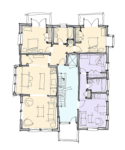
We're walking the talk with a "Not So Big Office"--reducing our square footage by about 30%. With the more compact, efficient layout we still have the same capacity for workstations we had in the old space. With fewer square feet and a lower rental rate per square foot our rent will be half what it was. We will put that extra cash toward paying ourselves more equitably, additional employee education and better employee benefits.
Our tenant improvement work was simple, and executed quickly and affordably by Odyssey Builders. We combined two suites into one, painted with our favorite paint, Yolo Colorhouse, and will be installing efficient T-5 Lightoliler PowerWash uplights brought from our old space on track reclaimed from Lightolier Northwest's showroom relocation. We'll also be relamping our Tech Lighting track lights with LEDs from Lighting Supply. We were able to salvage and reuse virtually all of the reclaimed fir and pine and recycable polyetheylene partitioning system and all of the FSC-certified plywood bookshelves built by former employee Michael Lentz in the new space. We left behind only the cork floor from Ecohaus.
The move itself was quite smooth. We (well, Geoff mostly) had already taken everything apart in the days preceding, and packed everything possible into 70 Frogboxes. Frogboxes (http://www.frogbox.com/) are reusable, recycled plastic boxes similar to Amazon Fresh boxes but bigger, which you rent and return. After investigating moving by bicycle and finding that too much to organize in the time we had, we hired EcoMovers. (http://www.ecomoversmoving.com/) They brought five guys and two small trucks, and in four hours moved all of our stuff out of the old place and into three different places in the new building (our suite on the 5th floor, a temporary staging area on the 2nd floor, and our basement storage room) for a bit over $1,000.
It's hard to believe we've been here almost a month. We still have a fair amount of organizing to do, but we're up and running and getting started on new projects. We'll have an open house in the fall--please come and visit!
Rooted Foods is a volunteer organization committed to promoting products that are truly rooted in their communities - healthy, unique products that contribute to helping communities sustain self-reliance.
Betsy Power--a work-study student of Rob's back in the day--and Kitty Brosnan have created lists of products you can buy, and companies you can buy from, that directly help to strengthen social, environmental and economic fiber of the communities from where the products came.
From Prickly Pear Marmalade to Purple Corn Organic Flour, the idea of eating delicious food to help others is delightful.
Voting will remain open until December 1, 2009 — so make sure to place your votes before the deadline, and spread the word to your networks. Winners will be announced in January 2010.
One Bus Away is a favorite application around the office. It makes using the bus system as primary transportation much easier. Through the phone number, website, SMS, iPhone app or text-only pages for older phone you can get real-time bus arrival times.
For a quick look into Passive House (Passivhaus in German) criteria and design strategies, take a look at Passive House on Wikipedia, the free Encyclopedia. The article has diagrams, a history of Passive House and the standards for creating a building that requires 1 BTU/square foot/degree day.
Passive House buildings use 75% - 95% less energy for space heating and cooling than new buildings that meet current US energy efficiency codes. This summer Rob and Matt both took the Passive House Consultant Training course. We are excited to put these standards into practice.
Chris Grygiel of Seattlepi.com talks about the new ordinance approved by Seattle City Council that will allow cottages to be built on single-family zoned lots. City Councilman Tim Burgess suggests, “That’s a positive way to create affordable housing in our city.”
Northern Lights from the O Ecotextile Collection - the same drape and luminosity as silk velvet. Seattle-based O Ecotextiles, debuting in the U.S. this year, has been added to BuildingGreen’s 2008 Top-10 Green Building Products by the editors of Environmental Building News and GreenSpec®. This seventh annual award recognizes the most innovative and exciting green building products added to the GreenSpec® Directory during the past year or covered in Environmental Building News. For O Ecotextiles, being an “organic textile" means not just that a fabric uses organic fibers in the yarn, but that every step of the production process has been certified eco-friendly. The company produces elegant, sumptuous organic fabrics for residential and contract / hospitality design use.
The O Ecotextiles Collection - made from bamboo, hemp, abaca, ramie, linen and silk – offers 17 fabric choices and multiple colorways, plus custom. Their mission (which clearly parallels our approach to architecture) is to change the way textiles are made by proving that it's possible to produce luxurious, sensuous fabrics in ways that are non-toxic, ethical and sustainable, resulting in a fabric which is safe to bring into our homes. Their worldwide production partners do not support the sale and use of the thousands of chemicals used regularly in textile production that poison our soils, pollute groundwater, and devastate eco-systems. O Ecotextiles’ production partners treat their wastewater so it doesn’t degrade waterways. Their products do not contain toxic chemical residues. They are continuing to work on decreasing their carbon footprint. O Ecotextiles is currently available in select design centers and retailers throughout the U.S., as well as in London, and through Harrison Architects' interior design partner Barbat Design. Contact Frith to arrange a showing of the fabrics.
The good folks over at Washington Toxics Coalition have launched a new website: HealthyToys.org, a consumer guide to toxic chemicals in toys. A great resource for this time of year.
Today I came across a series of images I feel compelled to share, called Running the Numbers, by Chris Jordan. Chris is a photographer here in Seattle. You might say he's an Andy Goldsworthy of American trash; making statistics of our consumption visible and real with his painstaking photographic assemblages that manage to be horrible and beautiful at the same time. Here is his artist's statement and one of his images, reproduced here with his permission.
Running the Numbers An American Self-Portrait
This series looks at contemporary American culture through the austere lens of statistics. Each image portrays a specific quantity of something: fifteen million sheets of office paper (five minutes of paper use); 106,000 aluminum cans (thirty seconds of can consumption) and so on. My hope is that images representing these quantities might have a different effect than the raw numbers alone, such as we find daily in articles and books. Statistics can feel abstract and anesthetizing, making it difficult to connect with and make meaning of 3.6 million SUV sales in one year, for example, or 2.3 million Americans in prison, or 410,000 paper cups used every fifteen minutes. This project visually examines these vast and bizarre measures of our society, in large intricately detailed prints assembled from thousands of smaller photographs. The underlying desire is to emphasize the role of the individual in a society that is increasingly enormous, incomprehensible, and overwhelming.
My only caveat about this series is that the prints must be seen in person to be experienced the way they are intended. As with any large artwork, their scale carries a vital part of their substance which is lost in these little web images. Hopefully the JPEGs displayed here might be enough to arouse your curiosity to attend an exhibition, or to arrange one if you are in a position to do so. The series is a work in progress, and new images will be posted as they are completed, so please stay tuned.
~chris jordan, Seattle, 2007
Plastic Cups, 2008 60" x 90"
Depicts one million plastic cups, the number used on airline flights in the US every six hours.
Partial zoom:
Detail at actual print size:
Others in the series include Barbie Dolls, depicting "32,000 Barbies, equal to the number of elective breast augmentation surgeries performed monthly in the US in 2006," Plastic Bottles depicting "two million plastic beverage bottles, the number used in the US every five minutes." and Cell Phones, depicting "426,000 cell phones, equal to the number of cell phones retired in the US every day."
At the Greenbuild conference this fall the Cascadia Chapter of the US Greenbuilding Council offered up a challenge for green designers, builders and building owners to "go beyond Platinum." (Platinum is the highest current rating of the USGBC LEED rating system.) The criteria, for the first time in my mind, really address the issues of sustainability, including responsible site selection, limits to growth, habitat exchange, net-zero energy, a materials red list that bans a long list of chemicals, construction carbon off-sets, responsible industry, appropriate materials and services radius, recycling construction waste, net-zero water, sustainable water discharge, a civilized work environment (for commercial projects), healthy air and source control, ventilation, inspiration and education, and most surprising (and finally!) BEAUTY and SPIRIT.
Rob Harrison AIA, principal of Harrison Architects, will take part in a panel discussion on green design on November 30th. Press release follows....
______________________________
GLOBAL GREEN A lecture/panel series showcasing sustainable planning and design in the Pacific Northwest and Denmark
Green Architecture and Urban Design Lecture/Panel Thursday, November 30, 7:00 - 8:30 Kane Hall, Room 100, University of Washington
Don't miss this lecture/panel series with prominent local architects who will be showing recent urban planning and design work that exemplifies application of sustainable strategies.
The panel will feature Bert Gregory, CEO of Mithun, to present the firm's urban design plan for a sustainable neighborhood at Portland's Lloyd Crossing; Margaret Montgomery, NBBJ, to unveil design strategies for the new Gates Foundation Campus, influenced by Scandinavian models; Robert Miller, Bohlin Cywinski Jackson, to discuss the new Ballard Library; and Architect Rob Harrison, who will show his recently constructed Green Roof Workshop.
Diane Sugimura of Seattle's Department of Planning and Development will recap the the City's green building program in an introduction to the panel, and Jerry Finrow, UW Architecture Professor and former College Dean, will moderate a discussion following the panelists' presentations. The evening will be a rare opportunity to see projects that represent cutting-edge sustainable design at four different scales of work.
This is the first in the new GLOBAL GREEN series. The event is supported by the Northwest Danish Foundation and co-sponsored by the Green Futures Institute and the Northwest Center for Livable Communities, both in the UW College of Architecture and Urban Design. Watch for future events that will focus on Sustainable Energy, and on Civic and Green Infrastructure.
Just received this news from Sam Martin, author of ManSpace: A Primal Guide to Marking Your Territory, which includes my own garage for motorcycles as one of fifty "man spaces." (See lower right of cover.)
"Great news from the book world. Manspace landed at #29 on the BookScan bestseller list for the week of October 1. If you've never heard of BookScan I don't blame you. It's an industry insider tracking company established by Nielson (yes, that Nielson) that provides point of sale stats to publishing companies. They monitor book sales from all the biggest bookstores in the country including Barnes & Noble Inc., Walden, Borders and Amazon.com.
That means Manspace was the 29th bestselling adult non-fiction book from all those stores last week. And we didn't even have the full week to work with - the book came out on a Tuesday!"
Sam has created a website (www.manspacesite.com) where, ahem, men can upload descriptions and pictures of their own "man spaces." It's a bit tongue in cheek, and quite enjoyable.
We don't have our copy yet, but I suspect some editorial liberties may have been taken.... Honestly, I don't make Frith park the Mini Cooper outside!
AIA Committee on the Environment Case Study Tour: LITTLE HOUSE & BARBAT-HARRISON GARAGE Two recently completed residential-scale projects showcase innovative problem-solving, design, and building technologies. The Barbat-Harrison Garage was built predominantly with salvaged materials, and has a planted roof. The Little House by Dee Williams is a 150 square foot architect-designed off-the-grid mobile home, which will be towed up from Olympia and parked next to the garage for the event. Dee Williams and Rob Harrison will lead the tour, in Seattle's Mount Baker neighborhood.
Tuesday June 27, 2006 4-6pm
Visit the AIA Seattle website to register for the tour: http://aiaseattle.org/ce_060627_littlehouseandgarage.htm.
We have an opening for a project architect/designer with 5-7 years experience in residential architecture. For more information, please visit the Working at RHA page on our site, here:
One of our projects, the Harding Home, has been selected to be the AIA Home of the Month for March 2006! There will be a tour open to the public on Sunday March 19th, from noon ‘till 3pm. For details, click here: <http://www.nwhomeandgarden.com/openhouse.asp>. The AIA Home of the Month program goes back more than 50 years. It is a real honor to be selected.
The Harding Home was a huge and successful collaboration, with owners Tim and Heather Harding and general contractor Phoenix Construction our major partners in this endeavor, with a supporting cast of well, not quite thousands, but many many hard workers. Please have a look here at the full list. A big thanks to everyone involved!
As part of the AIA Home of the Month, the house appears in a 7+ page spread in the March/April 2006 issue of Northwest Home + Garden, on your news stand now. The fabulous photos were taken by my friend (and our second-story addition client) Marco Prozzo. <http://marcoprozzo.com/ > I think you will be able to see some of the photos on the Northwest Home + Garden web site starting in March: <http://www.nwhomeandgarden.com/ > The focus of the March/April issue is green building.
My first employer has an exhibit at the Seattle Art Museum, on now. I worked for Isamu Noguchi and Buckminster Fuller shortly after I graduated from architecture school in 1979. The office is now the Noguchi Museum in Long Island City. It was an incredible experience. At 75, Isamu had more energy than most of us 50 years his junior. A true genius.